
I'm a US Citizen
ICE / dirty snow / Divya’s Kitchen / Valentine’s Day / < 6min
Sometimes my friends ask me how it is in New York. They say I am in the eye of the storm. But the eye of the storm is usually quiet, just like life in New York feels to me on the surface. Also, the city is at the periphery of the broader immigration crackdown. ICE appears in small groups and quickly disappears when neighbors show up blowing whistles. Yet, following the news, it feels unreal to step outside and seemingly nothing has changed.
On days when I avoid the news and concentrate on my work, I feel surprisingly light, strangely unburdened. Sometimes I feel bad because I think I should be an activist. Sometimes I give activists money and that makes me feel better.
In New York I usually walk or I take the subway, even though I don’t like when it’s too crowded to work on my laptop, which I carry everywhere. Sometimes I take a car and am glad when the driver isn’t chatty but lets me mull in my thoughts. Towards the end of a ride, I often get curious about those drivers, who are rarely white and often speak with an accent. I know I am not supposed to ask people where someone is from – I learned that at my employers’ diversity training- but after a brief internal debate, I usually do. My next question, after they said Equador or Kenia or Peru, is about ICE. And then they assure me, smiling, that they are not worried. Why not? “I am a US citizen.” Your word in God’s ear, I think, trying not to dwell on video footage of Latino Walmart clerks dragged from their workplace while repeating that very sentence. I am a US citizen!
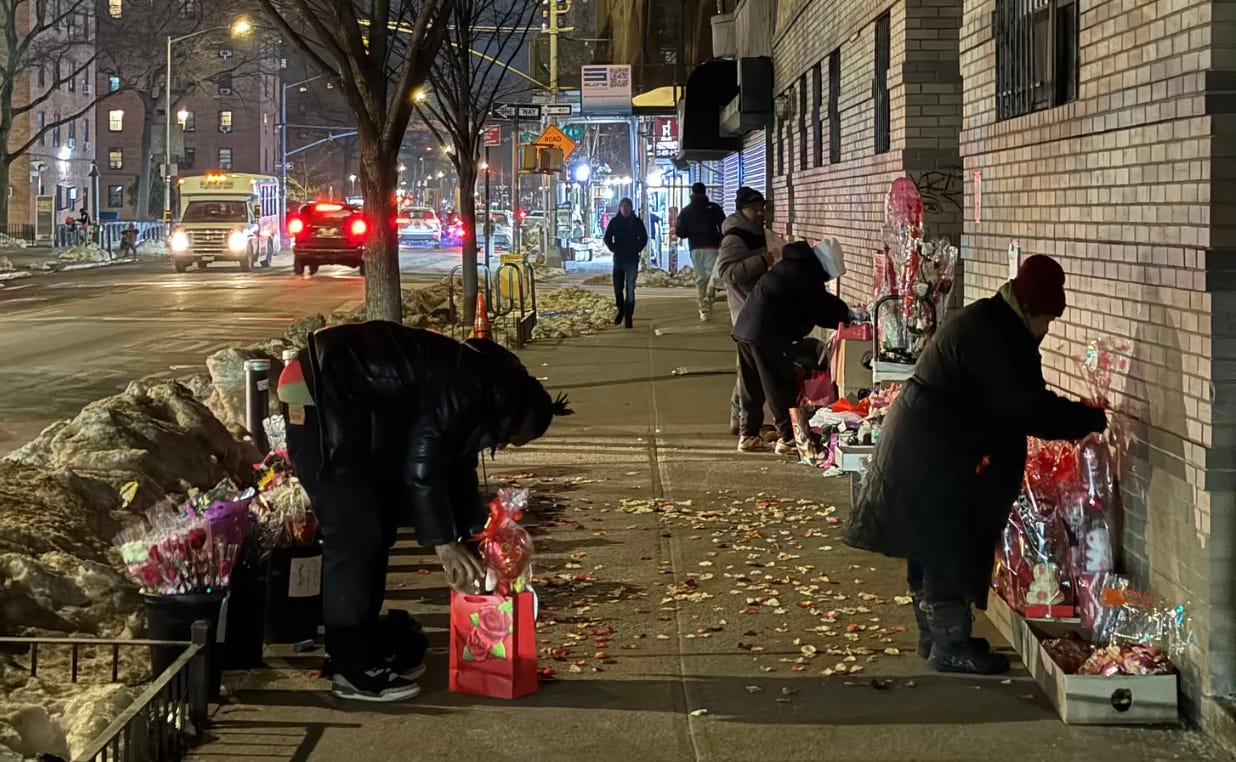
I am a US citizen myself, which complicates my German tax situation, but enables me to work for a New York real estate firm developing low-cost, high-impact design concepts for troubled office buildings. Sometimes I spend hours arranging material samples on trays or defending my preference for wood baseboards over vinyl, then again chat with someone I meet on my way to the fourteenth floor bathroom, where I look out the window on Fifth Avenue, wondering if that convoy with the sirens means that Barron Trump is escorted to school again. Likely the NYU at Washington Square, where I sit under trees after work in the summer and write. But now it’s February and the thaw has begun after a hard winter. The other evening I went jogging by the East River, still dotted with drifting ice, while it was getting dark. On my way back I jumped over dirty piles of harsh snow on the streets of alphabet city, and then passed by some bundled-up figures wrapping up their illegal flower stand in an unlit spot behind a drugstore on Avenue B. I used to not think much at their sight. Now I think that those flower vendors can be plucked off from the street any time and easily and without much notice. Why don’t I buy my flowers from them?
That same morning, I was supposed to receive roses for Valentine’s Day, but since the old building I live in lacks a doorman delivery failed. My boyfriend in Spain got a refund. We quarreled about it over the phone. Why wasn’t I home when the flowers arrived?
By the Evening I had forgotten about Valentine’s Day. I walked to Divya’s Kitchen on 1st Street without a reservation, just thinking about the geometric wall design which I wanted to work on over dinner. I was surprised to see the chef herself by the door in her bright white kitchen uniform. It’s our busiest day in the year, Divya said, and found me a place on the communal table. I refrained from opening up the computer, to not disturb the romantic atmosphere with all the candles. Instead I took analogue notes and drew long lines and circles with a dull pencil. Then Divya sat down with me for a minute and spoke about the tough time the restaurant is going through. Most months they just break even; there is no cushion. ”It just built up.” That’s why they had to close for ten days earlier this month. Concerned regulars reached out and asked how they could help. One woman donated twelve thousand dollars, which enabled them to pay the staff and reopen and buy time while they look for investors.
“How do you manage to still be so joyful”, I ask, “to radiate such sattvic calm?” I use the Sanskrit term I learned in her Ayurvedic cooking classes during Covid. Divya smiles. “I remember who I am on the highest level.” Of Bulgarian descent, she had been a monk in India, in charge of the kitchen, before she came to New York and opened her restaurant. She has held herself to the highest standards, in her ingredients and in the way she runs the place, despite the tough economics of New York. Now I cautiously ask if it makes sense to adjust to a slightly more capitalistic mindset. When I water down what I stand for, I lose my blessings. She smiles again. And I try to think of something encouraging that doesn’t sound stupid. We agree that life is all about challenges. Life is just one damn thing after another, I misquote Churchill, who used the phrase about history. “It’s not so much about the challenges”, she says, “it’s about who you become in the process.”
A little later, while I enjoy my Nori Paneer with raisin-cranberry sauce, she asks if she may seat a nice person across from me. It’s a woman in her early seventies, slender, with grey-black hair and a black-and-white Palestinian shawl draped around her shoulders like a stole. Her radiant curious smile makes me put away my work for good. I remark on her shawl and she reminds me of the proper word. Keffiyee.
We talk about showing support, despite the difficulty of taking sides in a conflict where there is so much hurt on both sides. Sometimes people say thank you.
My dining companion is of Romanian Jewish descent, a dancer and artist who has lived in her loft on Canal Street for fifty-one years. When I mention my series Can I See Your Home, Please? she tells me a wild story about her building, involving the Mafia. I catch only fragments through the background music in which her voice is rising and falling like waves. She reinforces her words with deliberate articulation, and I begin to wonder whether her voice is connected to her slightly asymmetrical face - which, as I learn shortly after, is the result of a Rottweiler-Labrador mix biting her when she tried to hug him. It took many years and electric treatments until her mouth came back to normal, yet even now, she says, she is still shocked when looking in the mirror, and more so on pictures. “It didn’t stop me from hugging dogs”, she laughs.
When her vegan lasagna arrives, it’s time for me to leave. She stands up and gives me a hug. On the way back through the late-night crowds in the East Village I read one of her poems on my phone. It’s about the pollution on Canal Street in the Eighties.
The next day the artist writes to thank me for dinner - I had, on impulse, asked the waiter to add her order to my bill. She now offers to order a keffiyeh for me and invites me to see her home on Canal Street, when I am back in the city in April. I look forward to visiting her, two months from now.
We’ll know more then. Or…